In week five, what knotless braids can you afford to sit through and still enjoy? Unlike many lists that detail the various knotless braids, they all essentially sound alike by the sixth listing, as they are organized primarily by name. In this list, they are organized primarily by the choice each braid presents to you: the thickness of the braid, the length of the braid, the tone of the braid, the location of the braid, and whether or not the ends are closed.
There will be over ten options listed below, each organized so that none directly answers the same question. Each will include a trade-off as that is what the images do not show specifically.
Side Braids With Knotless
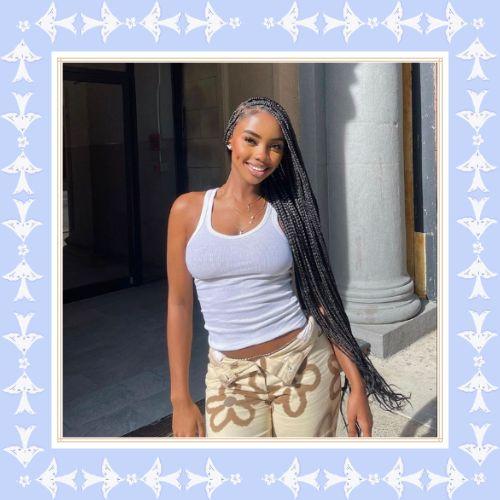
Image source: Pinterest
Because you side part roughly 6 to one side and 4 to the other, the side that becomes slightly loosened first (usually where the braider fails to get credit) because there is less braid covering fewer sections of your hair, ultimately creating even tension when it is done.
In week one, sleep on the lighter side. This is when the other side will start to define itself. To see how this side part looks across different styles without having to book each (as you can now see in our side part braids guide!), check them all out here.
Small Knotless Braids Styles
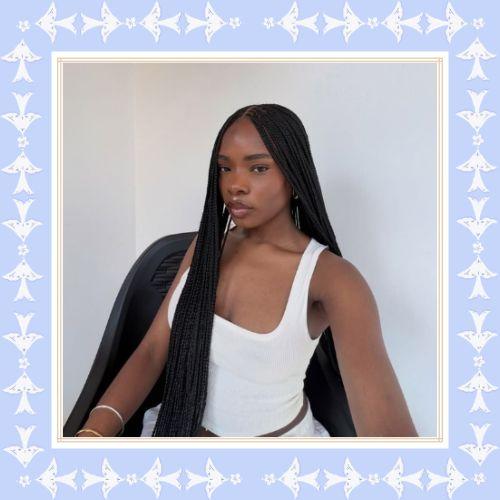
Image source: Pinterest
For small knotless braids, this measures 0.5 inches. What people do not tell you? Every braid essentially wraps around a thinner strand of your hair, creating more tension on any one root than a medium knotless braid would be, even though it ultimately feels lighter on your head.
By week four, this would win the right to stay on longer because by then, the medium braid would have likely begun to look loose at the top while the small looked intentionally put together. Redo your hair every five weeks, and this debate would be gone - as the medium would be the better choice. For those wanting to be done until the next season, this small or micro braid is the choice.
Curly Ends Knotless Braids
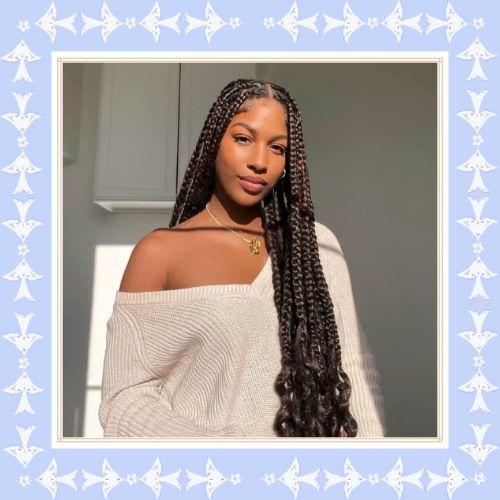
Image source: Pinterest
The braider stops braiding at what she calls the waterline, ties off, and lets the last few inches hang loose. Everything follows from where that line sits. Higher, and you get more volume and more tangling. Lower, and it looks like a plain set with split ends.
Synthetic hair frizzes at two weeks; human hair weave holds longer. If you want the curl to start at the root and run the whole way down, which salons call boho knotless braids style, it is a different install, and our braids with curls guide covers that one.
Knotless Braids With Highlights
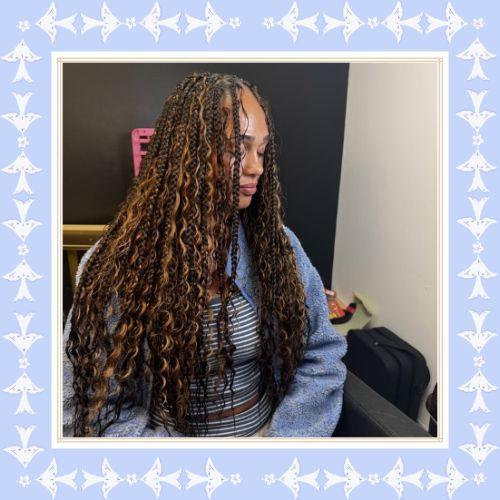
Image source: Pinterest
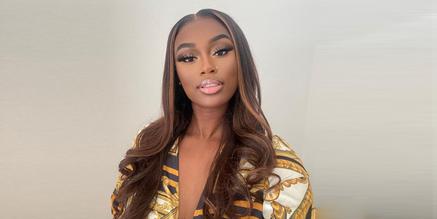
For knotless braids with highlights, this is both a color and placement choice. To make it so that highlights are visible when the hair is lowered but invisible when pulled up, we distribute the lighter braid evenly across the top layer. Depending on placement (not color) will determine if someone can see the highlights. Two different hairstyles from the same color and two different placements.
Large Long Knotless Braids
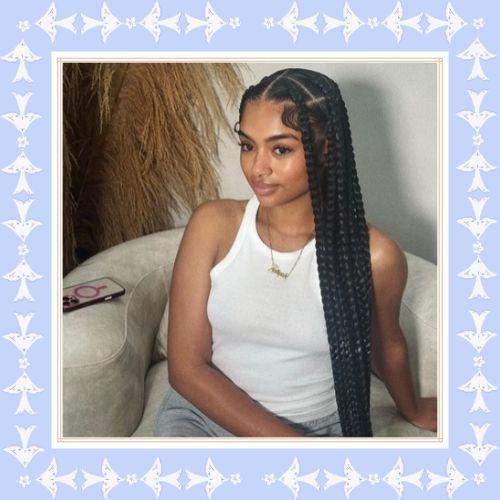
Image source: Pinterest
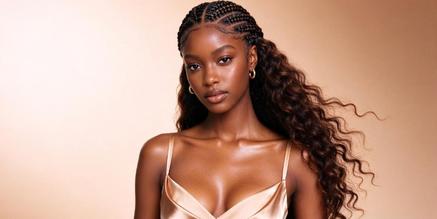
It’s not about wanting a certain length. It’s about wanting a certain weight, which is determined at the roots. By making a set that is waist-length, you are putting a long lever on every braid. Even though you are distributing the weight over more braids, each section now has increased load. That is why making a set of 60 to 80 one-inch sections, done in five to six hours, is stronger than doing a jumbo knotless braid style set to the same length - fewer inches are hanging off each section.
Triangle Part Knotless Hair Braids
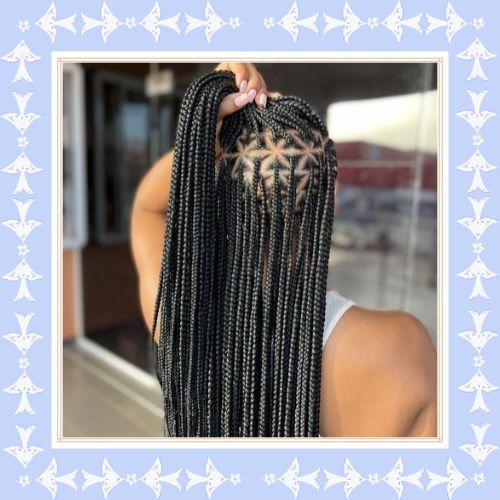
Image source: Pinterest
Square sections give you a grid: even and flat at the top, because every row lines up. Triangle sections stagger, so the braids above your forehead do not all start on the same line and the top sits softer and higher. What trade here is that your scalp becomes the pattern. To maintain it, keep it clean along the lines, avoid putting product on it for the first week, and do not use heavy oils.
Burgundy Knotless Hair Braids
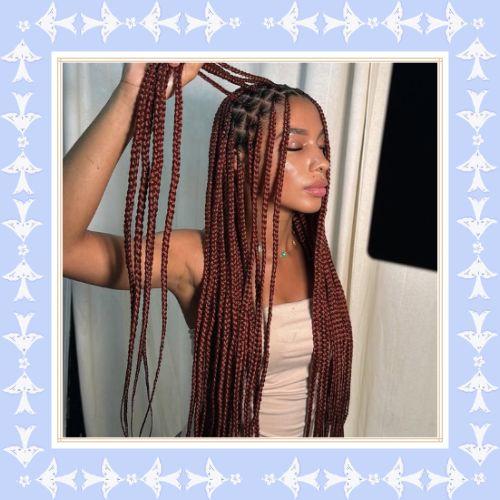
Image source: Pinterest
Burgundy knotless is the strongest single decision on this list, and it comes with the strongest single drawback: the moment your own roots come in, the line between them and the braid is the first thing anyone notices. A jet-black set hides a month of regrowth. A 99J set starts showing at two weeks.
Roots cannot be touched up on their own. Color is a whole-head decision — so a set you keep for three months is a set you pay for twice.
Cute Knotless Bob Styles
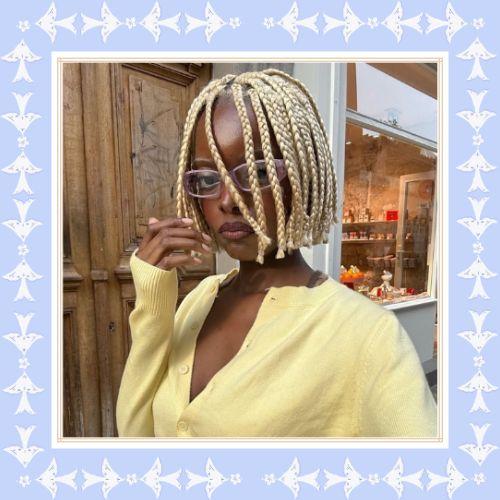
Image source: Pinterest
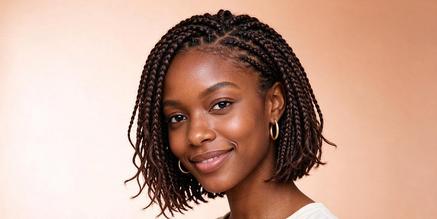
A bob braid hair ends at the nape, lighter, faster to dry, easiest takedown here. The finish is where it goes wrong: blunt ends read as a bob, tapered ends as a haircut that stopped early. It is best for anyone who washes weekly without planning around it. Say which finish you want out loud.
Ombre and Color-Melt Knotless
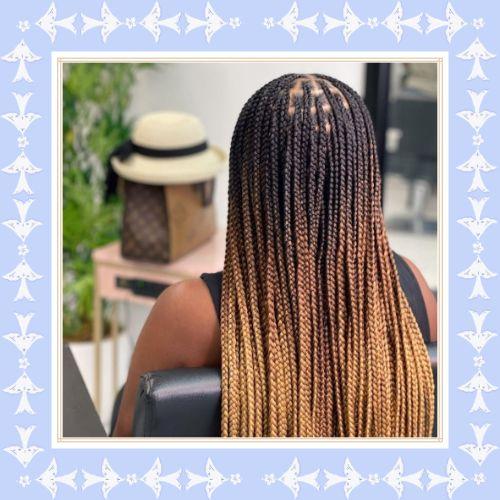
Image source: Pinterest
Instead of asking “what color” is ombre, people should be asking “what happens when it grows out?” Since the root end remains close to your natural color and stays dark, it gradually becomes blended as it grows out. Even when it grows out, the set looks intentionally done. A color melt does the same thing with more steps in between, softening each jump so the transition reads as light rather than as stripes.
Fulani Knotless Braids
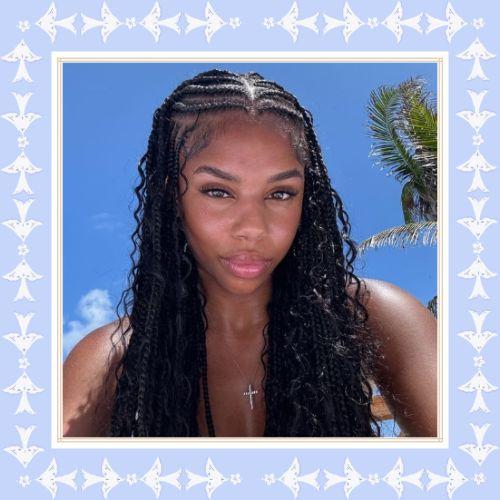
Image source: Pinterest
Fulani is not one style but two: a series of fine repeating patterns that are laid flat against the scalp, typically centered with a part that leads into the fulani style. Beyond that, others are regular individual braids. What makes this cool is that the front is where people want to focus (where everyone takes pictures), and the back is where people want the braid to comfortably be.
Half-Up Half-Down Knotless Hairstyle
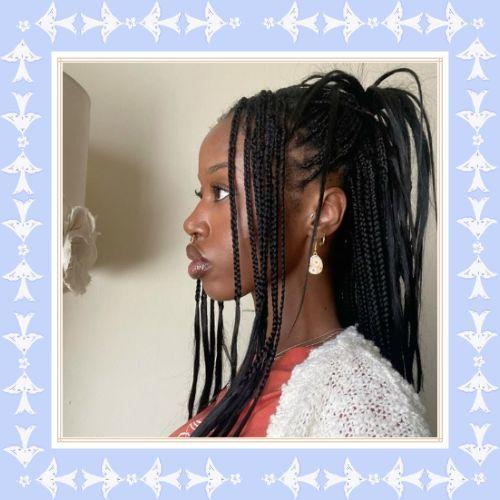
Image source: Pinterest
Half-up is decided before she picks up the comb, not after. If the top sections are installed as tight as the rest, gathering them will either slip down your head by lunch or drag at the front hairline, and neither is fixable without redoing them. Half up braiding hair is one of the few different ways to style knotless braids that costs nothing extra at the salon, which is exactly why it is worth mentioning at the start of the appointment rather than the end. Say it before she starts, not when she reaches the front.
Knotless With Cuffs and Beads
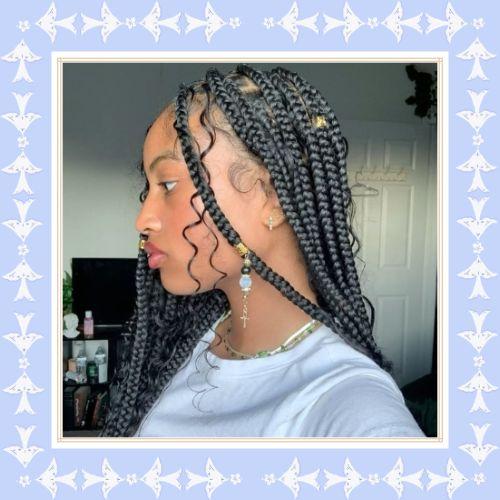
Image source: Pinterest
Accessories are the only thing here you can change without booking anything. But there is a rule: never put anything close to your head because the weight should be at the end of the braid. Using large beads up the first third of a braid will ultimately transform into something that becomes a problem because it will pull on your hairline. Because cuffs are lighter than beads of equivalent size, putting in a full row will ultimately look like more decoration but with less weight. Add everything after the install is finished, never during, and take it all off before you take the braids down. For more beaded ideas, our knotless braids with beads guide goes further.
Stitch Braids With a Knotless Base
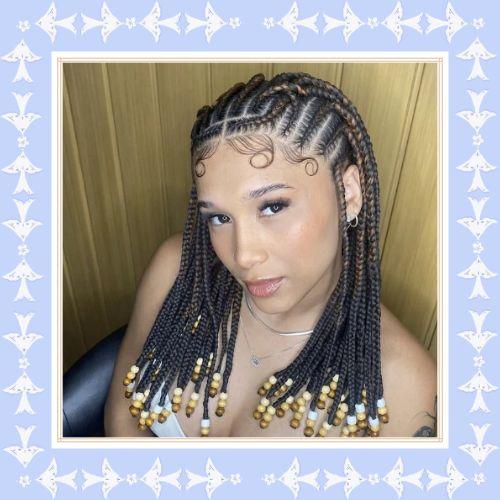
Image source: Pinterest
Called stitch braids because they’re actually sewn with tension to ensure every row is even and flat, or they will become wavy. This is essentially cornrows but with extension hair - the difference from the previous braid style. This will be the highest tension of all braids discussed.
To minimize the tension at this vulnerable area, request to only do your hair (no extension) for the first row. This will significantly reduce the pulling at this issue. If you are already experiencing a thin hairline, consider low-tension protective styles before choosing this option.
FAQ about Knotless Braids
What is the difference between knotless and box braids?
They are from the same family but have different beginnings. With box braids, a knot is tied at the root before inserting the hair extension. With knotless braids, instead, you stitch in two or three strands of your hair, which then feed the extension in to create a more flattened root. We also cover more details regarding knotless vs. knot braids.
Do they work on fine or short natural hair?
Yes, but with a difference: because your natural hair is short or fine, you will place less of your hair into each braid. Because of this, rather than focusing strictly on length, proper section size is important: choosing to go one size up will likely result in the knotless braids being closer to your scalp. For extremely fine hair, you may also want to avoid using longer, heavier sections.
How long will I be in the chair?
It scales with section size more than length. A jumbo set is a morning; a small set takes a full day; micro runs into a second day for most braiders. Book the earliest slot you can get, because the last hour is when hands slow down.
How long do knotless braids last?
According to dermatology, braided hair can last up to eight weeks. That is not necessarily determined by how they look anymore. Generally, jumbo braids will begin to show new hair growth around four to six weeks. Small braids can still look intentional up until seven or eight weeks.
How much do knotless braids cost?
In a US salon, a medium set at mid-back length runs roughly $200 to $450 depending on city and stylist. Small, extra-long, or heavily patterned work goes past $600. Prices vary more by city than style. Doing it yourself means $40 to $80 in hair alone.
Can I wash knotless braids?
Yes, and you should, every two to three weeks, with diluted shampoo in a pointed-tip bottle so you can reach the scalp between the rows. Rinse by squeezing, not scrubbing. Wet the braids before swimming and rinse after. Air dry fully before you tie anything down, and never sleep on them while still damp.
How many packs do I need?
For a full knotless braids set at mid-back, medium takes six to seven packs and small seven to eight. Bulk hair and pre-separated packs are counted differently, so the number on a bag is not the number you need. Check human hair bulk for braiding first.
The Order to Decide In
The order matters more than the style. Settle the section size first, because it decides both your chair time and your budget; then the length — because that is a weight decision; then color and ends, which are the only parts you can change later without a full redo. Pick the knotless braids that fit the week you actually have, not the week in the photo.
And if the week you have is a Tuesday with no spare day in it, pre-braided wigs from UNice are hand-braided on a lace cap, so the parting line is already set. No appointment, no chair time.