You already know the feeling. You post the selfie, zoom in, and there it is: a faint ridge where the lace should have vanished. At brunch, a friend's eyes drop to your hairline half a second too long. Great from across the room, questionable from twelve inches away. That gap almost always comes down to one thing: the lace.
Here's the short answer to HD lace vs transparent lace vs Swiss lace:
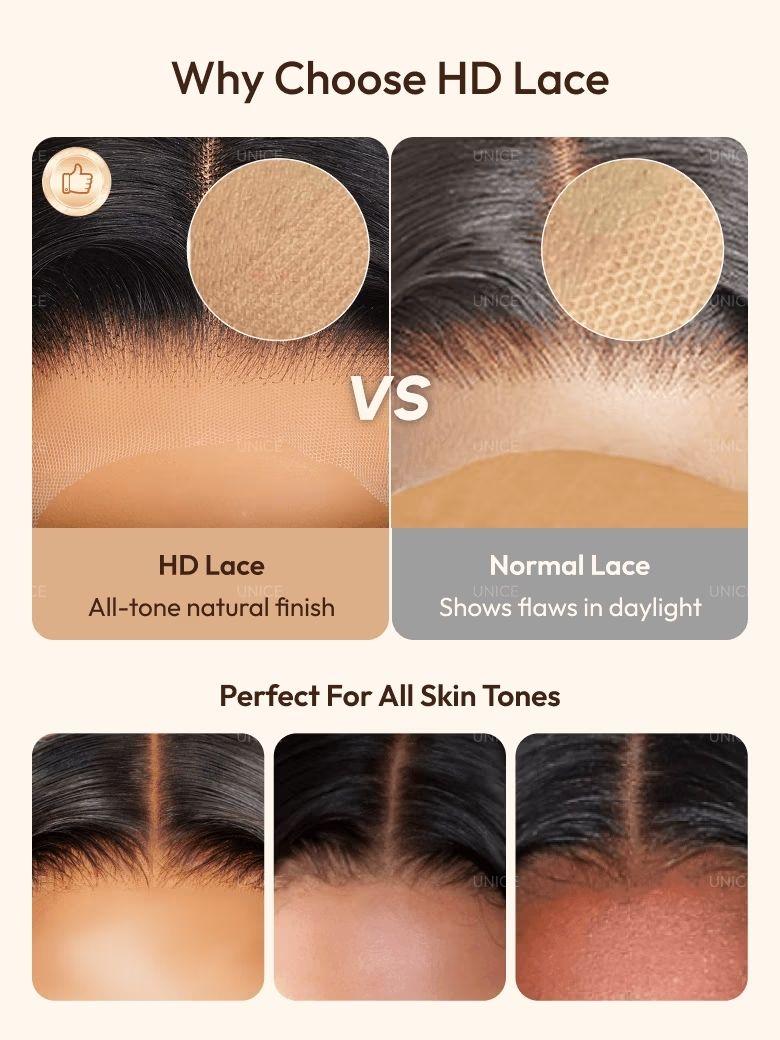
Image: Wig by UNice
- HD lace: the thinnest and most undetectable. Built for events, photos, and any moment a camera gets close.
- Transparent lace: slightly thicker and noticeably tougher, which makes it the everyday workhorse and the friendliest pick for beginners.
- Swiss lace: the middle ground, with the best balance of breathability, durability, and long-wear comfort.
Your choice comes down to three things: your skin tone, how often you wear it, and whether you're optimizing for photos or for longevity.
That's the 30-second version. The rest of this guide breaks down blend, durability, cost, and skin-tone match for each material, so you can choose once instead of buying twice.
What Is HD Lace?

Image: Wig by UNice
HD lace is an ultra-thin, high-definition lace engineered to sit so flat against the skin that it mimics bare scalp rather than fabric. The "HD" stands for high definition, and the name is literal: the mesh is delicate enough to fade under studio lighting, ring lights, and phone cameras. If you want the construction details, start with what HD lace actually is, then come back here for the comparison. And if you're weighing constructions against one another, film lace vs HD lace is the next distinction worth knowing.
What an HD lace wig gives you is an edge with no visible boundary. Because the material is so fine, it adapts to virtually all skin tones and copies the scalp rather than sitting on top of it. On camera, that translates to a hairline that holds up to inspection: the kind of finish you want for a wedding, a video shoot, or a milestone birthday where every guest has a phone.
The trade-off is that thin lace asks for gentle handling. HD is the least forgiving of the three if you snag it with a comb, sleep in it roughly, or pull it on and off without care, and it typically costs more than the alternatives because the material is harder to produce. That's not a dealbreaker; it's a use case. HD is the lace you reach for when the look matters most, and the one you pair with a sturdier unit for everyday wear.
What Is Transparent Lace?
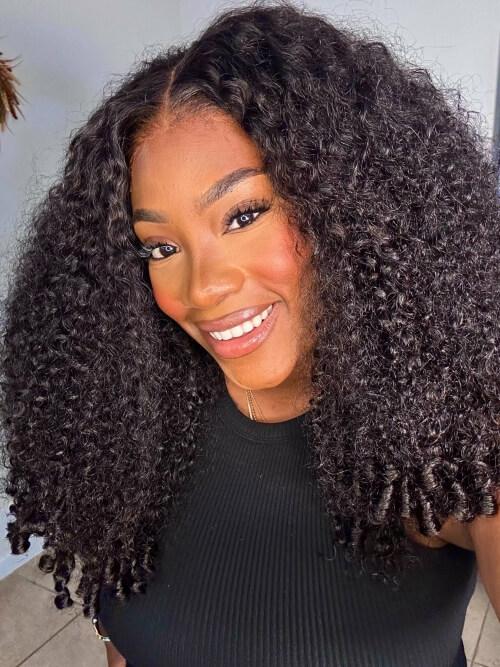
Model: @ieasha.no.curry | Wig by UNice
Think about the wig you'd wear to work on a Tuesday, to the gym, and then out for dinner without a second thought. That's transparent lace. Transparent lace wigs use a slightly thicker mesh than HD, and that extra body is exactly what makes them tougher and longer-wearing.
The material is called "transparent" because the fine mesh visually disappears against light-to-medium complexions straight out of the box. It blends well, creating a seamless hairline, and it holds up to regular installation and removal far better than its thinner cousin. For a lot of people, especially first-time lace front wig wearers, this is the material that removes the fear: it's harder to tear, easier to tint, and more forgiving if you're still learning how to melt your lace.
Transparent lace has two catches worth knowing before you buy.
- First, matching: because it reads as neutral rather than skin-tinted, it may need a little customizing depending on your tone, and a quick tint with foundation or lace tint closes the gap.
- Second, it's slightly thicker than HD, so it can't quite match HD's disappearing act on camera. If you have a deeper complexion, though, that first catch becomes your advantage. Brown lace isn't a fourth material: it's transparent lace tinted to a brown scalp shade, and it delivers one of the most natural results available for deeper skin tones.
HD vs Transparent vs Swiss Lace: Side-by-Side Comparison
HD Lace vs Transparent Lace
| Feature | HD Lace | Transparent Lace |
| Material | Ultra-thin, high-definition lace | Fine transparent lace, slightly thicker and more durable than HD |
| Blendability | Adapts to virtually all skin tones | Best match for light to medium tones; tint to a brown scalp shade for deeper tones |
| Visibility | Nearly invisible — the most undetectable hairline, even on camera | Seamless on light to medium tones; needs tinting to reach the same effect on deeper tones |
| Durability | Delicate; requires extra care during install and removal | Moderate and forgiving; the most reliable choice for everyday wear |
| Best For | Events, photos, and camera days — the invisible hairline | Everyday wear, repeat installs, and first-time buyers |
Swiss Lace at a Glance
| Feature | Swiss Lace |
| Material | Fine, delicate lace that still holds its strength |
| Blendability | Blends naturally on medium to deep tones; available in multiple colors to match your skin tone |
| Visibility | Subtle and natural; may read slightly more on very light tones |
| Durability | The best balance of delicacy and strength |
| Best For | All-day comfort and frequent restyling |
Which Lace Should You Buy?
No "it depends." Here's a direct route based on your skin tone and your week.
Which Lace Is Best for My Skin Tone?
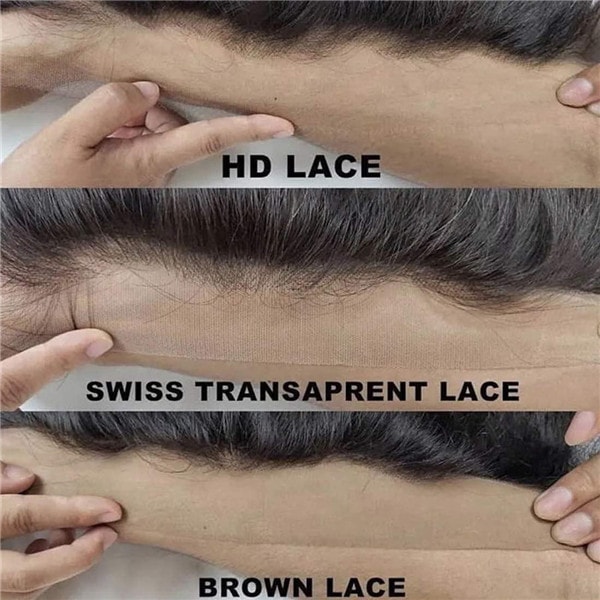
- If you have a lighter skin tone → HD lace is a seamless match. Its ultra-thin mesh adapts to virtually all skin tones, and against fair complexions it needs no tinting at all; it disappears on camera without extra work.
- If you have a deeper skin tone → go with transparent lace tinted to a brown scalp shade, the "brown lace" look. Tinted transparent lace is one of the most natural matches available for deeper complexions.
- Medium tones → you have the most flexibility. HD for undetectability, Swiss for a color-matched mid-weight option that blends reliably.
One clarifying note for deeper complexions: HD lace still adapts to virtually all skin tones, so it isn't off the table. The difference is handling. On deeper skin, HD rewards a closer, more careful install and precise tinting to read as seamless, while tinted transparent lace is more forgiving straight out of the box. That's why transparent gets the nod for the easiest deep-tone match.
Which Lace Fits Your Routine?
- For everyday wear and maximum durability → Transparent. It survives install, removal, and repeat wear better than thinner lace, which makes it the reliable daily pick.
- For the most undetectable hairline on camera → HD. Weddings, shoots, and any event where the lens gets close; HD is built for exactly this.
- For the best balance of comfort and longevity → Swiss. All-day breathability plus enough strength to restyle again and again.
If your skin tone and your scenario point to different laces, let the scenario win for everyday wear and the skin tone win for camera days. A regular Tuesday rewards durability; a wedding day rewards the invisible hairline.
How to Care for Your Lace Wig
Good habits are what separate a lace wig that lasts a few weeks from one that lasts much longer, and how you secure and style it matters for your natural hairline too. The American Academy of Dermatology advises keeping hairstyles that pull on the hairline loose to reduce traction-related hair loss, and research from Johns Hopkins on risky hairstyles and traction alopecia points to the same message: protect the edges, and don't wear tight styles around the clock.
Rotating between units isn't only easier on the lace. Research from Johns Hopkins on traction alopecia recommends removing weaves and extensions after six to eight weeks to give the follicles a rest, and alternating styles so the hairline can recover.
Alongside that, three habits do the most work for the lace itself:
- Store it on a mannequin head. Resting your wig on a stand between wears holds its shape and keeps the cap from collapsing or creasing.
- Detangle with a wide-tooth comb. Work gently from the ends up. A wide-tooth comb glides through instead of dragging, which is what tears thin HD lace.
- Skip frequent heat styling, and wash with sulfate-free shampoo. Heat wears down both the lace and the fibers over time, and sulfate-free shampoo cleans without stripping.
How you secure your unit matters too. Johns Hopkins researchers note that wigs held in place with clips and adhesives can cause significant breakage, which is one more reason a glueless or band-secured install is gentler on both the lace and your hairline. The AAD adds that hair should be pulled back loosely under any covering, and that silk or satin is gentler than cotton or nylon, so a satin cap or scarf is the kinder choice.
For a full routine, see our guide to taking care of your lace wig. And if you're deciding how much water exposure your unit can take, we cover that in Can You Swim in a Wig
FAQs About HD, Transparent, and Swiss Lace
Can I dye HD lace or transparent lace?
Yes. Both dye cleanly, but the method matters more than the material. Test your tint on a small excess piece of lace first — the flap you trim off during customization is perfect for this — and apply in thin layers rather than one heavy coat. Mixing two foundation shades usually beats a single color, because scalp tone is rarely one uniform shade.
What determines how long HD lace or transparent lace lasts?
Longevity is driven less by the calendar and more by how you treat the unit. Rotating between two wigs, storing each on a stand, and washing with a gentle sulfate-free shampoo will stretch wear far beyond daily use of a single unit. The lace edge gives you the earliest warning — once it starts thinning or fraying at the hairline, it's time to retire that unit.
Can I swim or shower with a wig made of HD lace or transparent lace?
Treat submerging as the exception, not the rule. Water and moisture break down adhesive and shorten the life of any lace unit, so for swimming, choose a secure, water-tolerant installation and avoid prolonged soaking. Showering with a glueless or band-secured unit is easier on the lace than a glued install.
Is it possible to cut the lace myself?
Yes — and cutting it to your own hairline is what makes the fit look custom. Cut in small sections, leave a touch more than you think you need, and trim just up to (never past) your natural hairline.
Can I style my hair freely with HD lace or transparent lace?
You can curl, straighten, and re-part both. Two rules keep the lace intact: always use a heat protectant, and let the tool do the work instead of pulling hard near the hairline. For edges, skip heavy gels that flake and dry stiff — they stress the lace and can tug at your hairline.
Is Swiss lace the same as HD lace?
They're related but not identical. Both are fine, delicate weaves, and you can think of HD as an ultra-thin, upgraded version of Swiss. Swiss keeps a bit more body, so it's more durable and more breathable; HD is thinner, so it disappears more completely on camera. Same family, different job.
Which lasts longer, Swiss or HD lace?
Swiss lace typically outlasts HD. Swiss retains more structure, so it resists fraying and handles repeated restyling better, while HD's advantage — extreme thinness — is also why it needs the gentlest handling. If you want one unit to carry you through a busy season, Swiss is the more durable choice.
Mini Verdict
Pick HD for events and the most undetectable hairline on camera, transparent for everyday wear and durability (and deeper complexions, tinted brown), and Swiss when you want the best balance of comfort and longevity. Three materials, three clear jobs — and now you know which one is yours.