
A wig length chart shows exactly where each wig length — from 8 inches to 32 inches — lands on the body when the hair is measured from the crown of the cap to the tip of the longest strand, stretched straight. Get that number wrong and a beautiful unit can still feel like the wrong wig.
Here’s how fast the gap shows up. A 20-inch wig falls near the waist on someone who is 5’2", but it stops around the mid-back — or even the armpit — on someone who is 5’9". Same number on the label. Same box. Completely different result.
If you’ve ever scrolled three reviews just to guess whether “18 inches” means shoulder or chest, you’re not bad at shopping. You’re working with a ruler that was never made for your body.
This guide puts all of it in one place: the inch-by-inch chart, four quick tables for texture, height, face shape, and price, and real answers to the questions people actually ask. Read it once, and you’ll order the right length the first time.
What Is a Wig Length Chart?
A wig length chart answers one question: if I order 18 inches, where will it actually sit? It lists each length in inches and centimetres, then matches it to a body landmark — chin, collarbone, shoulder, mid-back, waist, or hip. One rule to hold onto: length is measured from the crown of the cap to the tip of the longest strand, pulled straight — never from the hairline.
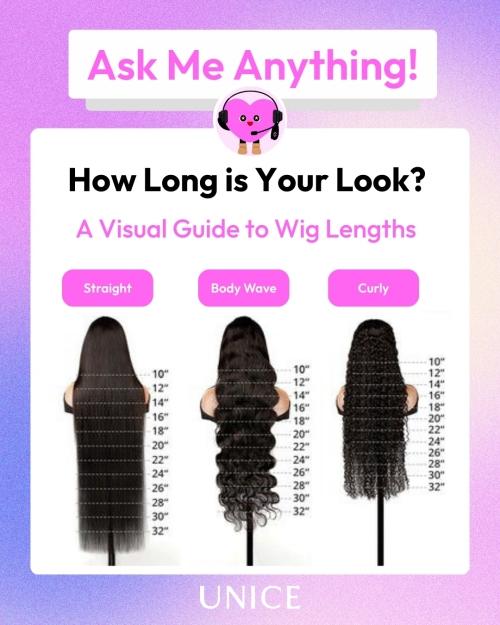
Image: Wig by UNice
Think of it as a translation tool. The industry sells length in inches; your mirror reads in landmarks — “does it touch my collarbone?” A good wig length chart converts one into the other, so the number you order matches the look you want.
Two things still change the answer: your hair texture and your height. That’s why this hair length chart doubles as a full wig length guide — the main table shows where each length falls, and the adjustment tables correct it for texture, height, and face shape.
Wig Length Chart: Where Every Length Falls (8–32 Inches)
Short answer: a 20-inch wig reaches the mid-back on most wearers, an 18-inch wig reaches the chest, and a 24-inch wig reaches the waistband. A 20-inch wig is measured from the crown of the cap to the tip of the longest strand, so on petite frames under about 5’4" it can graze the waist, while on taller frames it stops at the mid-back. If you want a guaranteed waist-length look, choose 24–26 inches.
This is the inch-by-inch wig length chart the label never gives you. The “where it falls” column assumes straight hair, measured straight; curly and wavy hair sits higher, as the texture table below adjusts for. Hair also grows roughly half an inch per month — about 6 inches a year, so a 20-inch strand is more than three years of natural growth (Cleveland Clinic on how fast hair grows).
| Length (inches) | Length (cm) | Where it falls (straight hair) |
| 8 in | 20 cm | Chin level |
| 10 in | 25 cm | Above the collarbone |
| 12 in | 30 cm | Collarbone |
| 14 in | 36 cm | Just above the shoulder |
| 16 in | 41 cm | Shoulder to upper chest |
| 18 in | 46 cm | Chest / armpit level |
| 20 in | 51 cm | Mid-back |
| 22 in | 56 cm | Just above the waist |
| 24 in | 61 cm | Waistband |
| 26 in | 66 cm | Below the waist |
| 28 in | 71 cm | Hip |
| 30 in | 76 cm | Lower hip |
| 32 in | 81 cm | Hip to upper thigh |
Same lengths, this time with the names you’ll actually see in a product drop-down — and who each one is for.
| Length | Common name | Best for |
| 8–10 in | Classic / short bob | Summer wear, workouts, and anyone who runs hot |
| 12 in | Lob (long bob) | First-time buyers who want a safe length that still reads styled |
| 14–16 in | Shoulder / collarbone | Office and daily wear; softens oval, heart, and square faces |
| 18 in | Chest length | The all-rounder — the most-worn classic length for everyday wear |
| 20–22 in | Mid-back / waist-grazing | Statement hair, photos, and events; drama without floor-length upkeep |
| 24–26 in | Long / extra long | Versatile styling for wearers who keep hair down; needs 150%+ density |
| 28–32 in | Super long | High-impact editorial and occasion looks; pair with 180% density |
Wig Length Chart by Height
Your height changes where a length lands — sometimes by a whole landmark. That same 20-inch unit reads “long” on a tall frame and “very long” on a petite one.
| Your height | Flattering length range | What to watch |
| Under 5’3" | 12–16 in | Very long wigs overwhelm a petite frame; 18"+ reads as floor-grazing |
| 5’4"–5’7" | 16–20 in | Most lengths work; a 20-inch wig lands around the mid-back |
| 5’8" and taller | 20–24 in | Shorter wigs sit higher; scale up about 2 inches for a waist-length look |
Wig Length Chart by Face Shape
The right length balances your features; the wrong one fights them. That’s really the whole game.
| Face shape | Best lengths | Why it works |
| Oval | 14–24 in | Balanced proportions need almost no correction; nearly every length flatters |
| Round | 18–24 in | Length below the chin slims the face instead of widening it |
| Square | 12–18 in + waves | Soft waves and a shoulder-skimming line soften a strong jaw |
| Heart | 14–20 in | Length at the jaw adds width below a wider forehead |
| Long / oblong | 12–16 in + volume | Short-to-medium length with width breaks up a narrow profile |
| Diamond | 16–20 in + side part | Length at the chin and cheek softens prominent cheekbones |
Not sure which shape you have? wig length for your face shape walks through each one with photos.
Why Curly & Wavy Wigs Look Shorter: Wig Length Chart by Texture
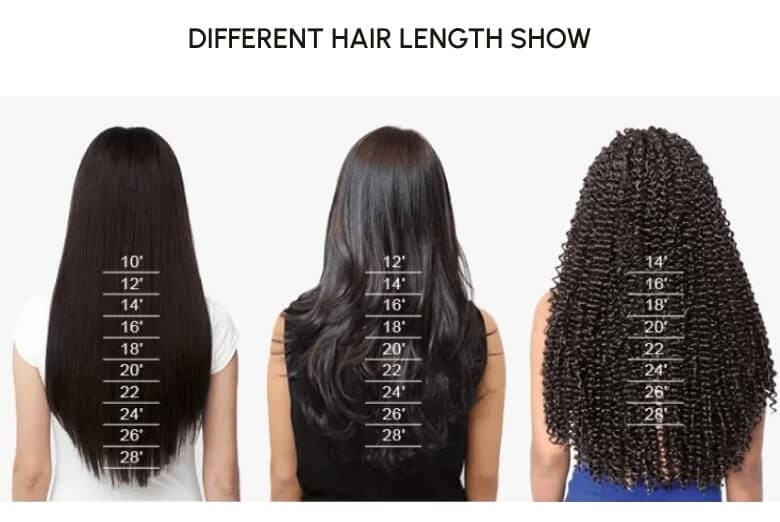
If there’s one section to read twice, it’s this one — it’s why so many “wrong unit” complaints are really just shrinkage. A curly wig is not shorter than its label; it is shorter than its label looks. Curls pull length up into bends, so the tape measure and the mirror disagree.
| Texture | Looks shorter by | Typical shrinkage |
| Straight | 0–1 in | 0–5% |
| Wavy | 1–2 in | 10–15% |
| Curly | 2–4 in | 25–35% |
| Coily / kinky | 3–5+ in | 40–70% |
The rule to shop by: decide the look you want, then buy 2–4 inches longer than that. If you love how a straight 16-inch wig falls at your chest, choose an 18–20 inch curly wig and you’ll land in the same place. Coily textures may need to size up 4–6 inches.
Prefer a gentler drop? A wavy wig loses just 1–2 inches, while a straight wig shows its true length all the way down. And no, your curly unit isn’t defective — that’s just shrinkage doing its thing. If you’re blending with your own hair, match the shrinkage at your leave-out so both lengths meet.
Shrinkage cost Marisol real money last summer. The 5’6" Miami buyer ordered a 22-inch curly unit for a wedding and panicked when it arrived looking like her usual 19-inch hair. She returned it, re-ordered a 24-inch, then realized the 22-inch had been perfect — the curls had simply pulled it up. The swap cost three weeks and two shipping fees, all because one line was missing from the chart: “curly hair sits 2–4 inches higher.”
How Do You Measure Wig Length?
Measuring takes a minute and explains why a unit you own measures “wrong.” Follow these three steps.
Step 1: Place the wig on a wig head or lay it flat on a table. If the hair is curly or wavy, gently straighten it as much as you can without pulling.
Step 2: With a soft tape measure, measure the longest strand from the crown of the cap — its highest point — to the end of the hair. Let the tape follow the strand, not the curve of your body.
Step 3: Note the number. If the wig isn’t cut symmetrically, measure a few sections the same way.
For cap size, lace placement, and a full beginner walkthrough, see our how to measure wig length and cap size guide.
Crown-to-End vs. Hairline Measurement
This is where most people go wrong. Wig length is measured from the crown, not from the hairline or the front lace edge. A wig labeled 20 inches isn’t 20 inches of hair hanging from your forehead — it’s 20 inches from the crown to the tip. Because the hair is layered over the cap, front strands can look shorter while the longest back layer is the length you paid for. Measure from the hairline and you’ll always log a number 3–5 inches short.
How to Measure Curly & Wavy Wigs
You measure them the same way — but you have to stretch the hair straight first. Curly and wavy hair is sold at its stretched, “true” length, so an unstretched tape reads far short of the label. Gently pull a single strand straight, then measure crown to end; that number should match the product page.
Wig Length Chart: Our Picks for Every Length (6–32 Inches)
A chart tells you where each length falls — the right unit tells you how it feels. Below, each length becomes a real style, with our top pick for it.
Pixie Cut Wig - around 6-Inch:
With a 6-inch pixie cut wig, this bold, beautiful style gives you effortless confidence with zero commitment. Perfect for everyday wear or a glam night out, it delivers volume, attitude, and a natural look that’s oh-so-easy to style.
8-inch wig:
The 8-inch wig is ideal if you want to stay cool on hot summer days or during a workout. It also suits short straight bobs, asymmetrical cuts, short curls, and beach waves. Stretched straight, 8 inches covers the chin and just reaches the collarbone.
10-inch wig:
The 10-inch wig suits women who want a short style but find 8 inches too short. It’s ideal for a longer middle or side bob, plus spiral curls. Worn straight, it sits just above the collarbone.
12-inch wig:
The 12-inch wig is the sweet spot for the ever-popular lob (long bob), delivering both shape and volume. Curly bobs and beach waves also work well at 12 inches. On straight hair it lands right at the collarbone for most people.
14-inch wigs:
14-inch wigs sit between medium and long. This length suits long bobs, wavy curls, spiral curls, and tighter textures, plus a bangs bob, an A-line bob, or a feathered cut. Worn straight, it hits a few inches above the collarbone — about the top of your bra strap.
16-inch wig:
The 16-inch wig handles a range of styles — loose waves, deep waves, small curls, and sleek straight looks. Straight out of the box, it skims the shoulder and settles at the upper chest.
18-inch wig:
An 18-inch wig is a true long wig and one of the most popular lengths for women. It falls from the shoulders and looks lovely in nearly any style: curly, silky straight, teasing waves, or anything you can imagine — beautiful, yet manageable.
20-inch wig:
20-inch wigs are long and a great choice if you want hair that moves with you and flows in the wind. Straight, this length reaches the mid-back — close to the waist on shorter wearers — making it ideal for stunning looks and memorable occasions. It flatters most face shapes, though it can feel warm if you run hot.
22-inch wig
A 22-inch glueless wig is perfect for beginners who want an eye-catching look. This length suits layered curls, wavy hair, and sleek straight styles. Straight, 22 inches sits just above the waist — long, but not long enough to sit on.
24 - 32 inch wigs:
When we talk about wigs longer than 24 inches, we mean “40-inch extra long wigs” wigs. These lengths fall nearly to the hips or lower and can be styled almost any way you can think of. Keep in mind they carry the most weight — and the most upkeep.
How to Choose the Right Wig Length
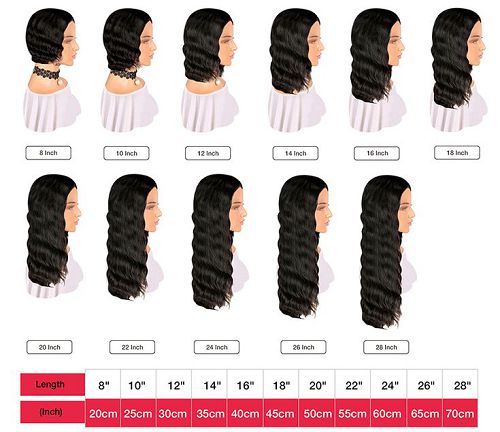
Where a length falls is only half the story. These seven things decide whether it’s the right length for you.
1. Length & Your Goal
Cut it shorter for a chic bob; go longer for a glamorous look. Just remember: the longer the wig, the more it costs and the more it weighs.
2. Texture
Curly and wavy hair shrinks up, so choose a length 2–4 inches longer than the look you want. Use the texture table above as your rule.
3. Density
A high-density wig stays full to the ends; a low-density one can look thin past the mid-back. For any length beyond about 20 inches, choose 150% density or more so the hem stays full. Learn more in our guide to wig density.
4. Face Shape
Face shape is a key factor in choosing a length. An oval face carries almost any length; a round face is flattered by a longer length that creates a vertical line; a square face suits a short-to-medium layered style.
5. Height
Your height decides where a length lands. Mid-length hair adds balance to a tall frame; very long hair can shorten a petite one. Use the height table above to match inches to your build.
6. Body Shape
It comes down to proportion, not size. Medium-length hair keeps a tall frame in balance, while a shorter cut often looks more proportional than very long hair on a petite frame. Nothing is off-limits — think about the line you want to create.
7. Lifestyle
If you lead an active life, a shorter wig keeps hair off your shoulders, neck, and back. If you keep hair down most days, longer lengths are worth the upkeep.
The “Size Up” Rule
When you’re stuck between two lengths, always choose the longer one. You can trim a long wig to any shorter length, but you can never add inches back. That single rule saves more buyers from regret than any other in this guide.
Ready to put the chart to work? Note the length you need before you start browsing, so you can filter straight to it — no guessing between sizes.
Wig Length & Price: What to Expect
Length is a big driver of price: a longer unit simply uses more hair, which means more material and more work. Exact prices also depend on texture, density, lace, and color. One quick note before you shop: a wig size chart is not the same as a wig length chart — size refers to your cap measurement, length refers to the hair itself.
| Length range | Typical price band | What you’re paying for |
| 8–12 in | Lowest | The least hair and weight — the most budget-friendly entry point |
| 14–18 in | Mid | The everyday range — most styles and the best value per wear |
| 20–24 in | Higher | More hair and a longer cut; density upgrades matter more here |
| 26 in and up | Highest | Extra-long premium hair; pair with high density to stay full |
Because the price gap is real, the “size up” rule comes with a caveat: go longer only if you love the length, not because you’re unsure. If budget is tight, the 14–18 inch range gives the most flexibility.
Most Popular Wig Lengths in 2026
The most popular wig lengths in 2026 are 18–22 inches, with 20–22 inches the favorite for both beginners and regular wearers. That’s the sweet spot — enough length to make a statement, not so much that wash day turns into a project.
A few years ago, 14–16 inches dominated. The shift toward longer everyday hair came with lighter glueless caps and higher-density builds that keep longer lengths full instead of stringy — so a 20-inch wig now feels as wearable as a 16-inch once did. Shorter bobs (8–12 inches) remain a warm-weather favorite, and 26-inch-plus units stay popular for events.
Common Wig Length Mistakes
Almost every “wrong length” complaint traces back to one of these four mix-ups.
- Mistake 1: Assuming 20 inches means waist-length. Straight, a 20-inch wig reaches the mid-back on most wearers; it only grazes the waist on shorter frames. Expecting waist and getting mid-back feels like a loss even when the unit is perfect.
- Mistake 2: Thinking your curly wig is the wrong size. If it arrived shorter than the label, that’s shrinkage, not a shipping error. Curly hair loses 25–35% of its length to the curl pattern, and coily hair can lose 40–70%.
- Mistake 3: Believing longer is automatically better. Past about 20–22 inches, weight, tangling, and thinning hems increase fast. A full, well-managed 18-inch wig usually looks better than a thin, stringy 30-inch one.
- Mistake 4: Measuring from the hairline. Length is measured crown to end, never from the front lace edge — hairline measurements always come up 3–5 inches short.
Priya’s story is a common one. She ordered a 24-inch unit for her birthday photos, certain longer meant more dramatic. By hour three, the weight had pulled the front hairline and the ends were tangling. She switched to a 20-inch and never went back — it moved better, sat lighter, and photographed fuller. Her takeaway: “The longest wig isn’t the best wig. The right one is.”
Two more habits protect your hairline: give your scalp a real break between installs, and keep the tension low at the front. Longer, heavier units are the ones most likely to pull, which is why the American Academy of Dermatology on hairstyles that pull and cause hair loss is worth a read before you commit to 24 inches or more.
Frequently Asked Questions
What is the most popular wig length?
18–22 inches. In 2026, 20–22 is the pick people keep re-ordering — dramatic on, but still easy to live with.
How long is a 20 inch wig, and does it reach your waist?
A 20-inch wig reaches the mid-back on most wearers. It only reaches the waist if you’re under about 5’4".
What wig length is best for beginners?
16–20 inches — forgiving to style and easy to manage. Many beginners start at 18 inches or a 12-inch lob.
Is 18 inches long enough, and how does it compare to 16 or 20 inches?
Yes. At 18 inches, straight hair falls around the chest and armpit — a natural, versatile everyday length. A 16-inch wig stops at the shoulder to upper chest, and a 20-inch wig reaches the mid-back. If you’re torn between 18 and 20, size up to 20 — you can always trim it back.
How many inches is a bob or shoulder-length wig?
A bob is usually 8–12 inches, and a shoulder-length wig is about 12–14 inches. An 8–10 inch bob sits at the chin or jaw, a 12-inch lob falls to the collarbone, and at 14 inches straight hair sits just at or above the shoulder.
How do you measure wig length?
Lay the wig flat, then measure from the crown of the cap to the tip of the longest strand, stretched straight. Never measure from the hairline. Our step-by-step wig length and cap size guide shows exactly where to place the tape.
Do curly wigs look shorter than straight wigs of the same length?
Yes. Curly wigs look about 2–4 inches shorter than straight wigs at the same label length, because the curl pattern pulls length upward.
Why does my new wig look shorter than expected?
Two reasons: shrinkage (curly and wavy hair looks 2–4 inches shorter) and measurement point (length runs from the crown, not the hairline). Both are normal, not defects.
Is 24 inches too long for a wig?
Not too long, but a commitment. A 24-inch wig reaches the waistband, carries real weight, and looks best with 150%+ density. Because it uses more hair, it also costs more than shorter lengths.
How do I choose a wig length for my face shape?
Match length to proportion. Round faces suit 18–24 inches, square faces suit 12–18 inches with waves, and oval faces can wear almost any length from 14–24 inches.
Conclusion
The wig length chart is your shortcut to ordering the right hair the first time. Measure from the crown, never the hairline. Remember that texture and height shift every number on the label. Lean on the popular 18–22 inch range for a safe, versatile choice. And when you’re stuck between two sizes, go one up — you can always cut, but you can never add.
For anyone new to wigs, length is only half the equation — a perfect length on a loose cap still won’t look natural. Before you buy, spend five minutes on how to measure your head for a wig to lock in a snug fit. When length meets the right fit, your unit looks like it grew there.
Hair loss from tight, heavy styling is a real concern for long-term wearers; loosening tension is the first line of defense — see the American Academy of Dermatology’s guidance on managing hair loss and the Johns Hopkins research on hairstyles and traction alopecia if you often wear hair pulled back.
Ready to find your length? shop wigs by length. From an 8-inch bob to a 32-inch showstopper, the right one is one measurement away.